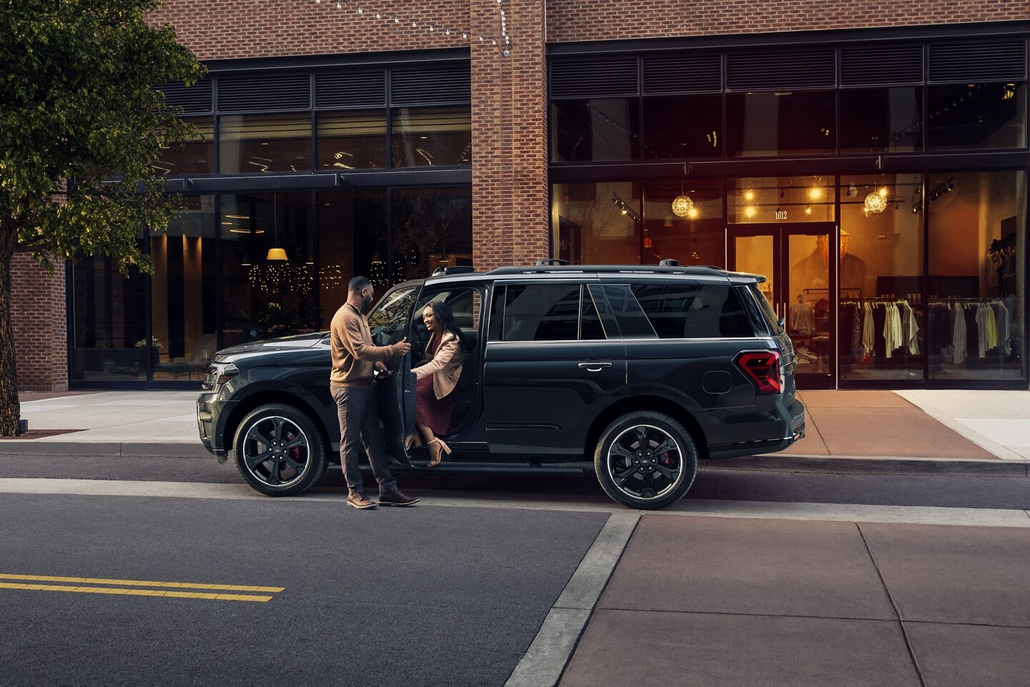

When it comes to full-size SUVs, the biggest players in every sense of the word are the Ford Expedition and Chevrolet Suburban. Both of these vehicles offer the promise of seemingly limitless capability. They can carry large quantities of family and friends and their stuff, tow big toys, and, with available 4WD, plow through snow-covered and unpaved roads without a care in the world. Benna Ford compares these two big boys. Size Starting with these model’s obvious attributes, the Suburban is clearly much larger. Fifteen inches shorter, the Expedition is actually closer to the Chevrolet Tahoe in size, while the stretched Expedition MAX approaches the Suburban’s length, though it is still 3.8 inches shorter. The Suburban’s size means that it will not fit into many single-family home garages. The Expedition XL is a five-seater, but all other trims have a third row to seat eight. Most Suburbans also seat eight, though there is a seldom-ordered option to replace the front bucket seats with a bench for a total seating capacity of nine. While the Expedition MAX closes the gap, the Suburban still has greater cargo space: Cargo Space (cubic feet) Behind: 3rd row 2nd row 1st row Expedition 19.3 53.6 104.6 Expedition MAX 34.3 79.6 121.5 Suburban 41.5 93.8 144.7 The difference is diminished when it comes to passenger space. The Expedition and the MAX have the same passenger space, and when comparing legroom against the Suburban, both 2nd-row and 3rd-row legroom differs by about half an inch. Drivetrains The Expedition counters with more modern engines. The Suburban offers 5.3-liter and 6.2-liter V8 engines as well as a V6 Duramax Turbodiesel. Generally, each Suburban trim offers two of the three engine choices. All Expeditions are powered by a 3.5-liter twin-turbo V6 in three available states of tune, which are determined by the trim level. V8 power may seem as American as apple pie, but the turbocharged V6s are the stars in this group. Expedition 3.5L Twin-Turbo V6 Horsepower Torque (lb-ft) XL, XLT, STX 380 @ 5,000 470 @ 2,250 Limited, King Ranch, Platinum 400 @ 5,000 480 @ 2,250 Limited Stealth Performance, Timberline 440 @ 5,000 510 @ 2,250 Suburban 5.3L V8 355 @ 5600 383 @ 4100 6.2L V8 420 @ 5600 460 @ 4100 3.0 Turbo Diesel V6 277 @ 3750 460 @1500 As seen above, the base engine of the Expedition has significantly more horsepower than the base Suburban engine. Its torque is greater than all available Suburban engines, including the diesel. Higher-tune Expedition engines increase the torque differences. At the same time, the Expedition provides greater fuel economy than both Suburban V8 engines. As the Superior, WI area is very much 4x4 country, the 4X4 figures are shown: Expedition 3.5L Twin-Turbo V6 EPA city/hwy/comb. mpg XL, XLT, STX (4x4) 16 / 22 / 18 Limited, King Ranch, Platinum (4x4) 16 / 22 / 18 Limited Stealth Performance, Timberline (4x4) 16 / 19 / 17 Suburban 5.3L V8 (4x4) 15 / 18 / 16 6.2L V8 (4x4) 14 / 18 / 16 3.0L Turbodiesel V6 (4x4) 20 / 26 / 22 The Suburban’s diesel engine has the best mileage of all, though this is somewhat mitigated by the higher price of diesel fuel. The greater torque of the Expedition engines contributes to greater towing capacity. Again, focusing on 4X4 models, the Expedition has a maximum towing capacity of 9,200 lbs., dropping to 9,000 lbs. for the MAX model. By contrast, the maximum towing capacity for a 4x4 Suburban is 8,000 lbs. with the 5.3L V8, 7,900 lbs. with the 6.2L V8, and 7,800 lbs. with the diesel engine. Interior and Technology Both models range from basic accommodations with cloth seats to absolute indulgence bathed in soft leather. For the Suburban, which starts at $64,195 with 4WD, basic accommodations include an 8-inch infotainment screen bumping up to 10-inch for the rest of the model line, analog gauges with a 4.2-inch information screen, a 6-speaker audio system, 10-way power front seats, and tri-zone climate control. The Expedition starts at $57,660 for an XL STX with 4WD, though that only includes seating for five. The 8-passenger XLT with 4WD starts at $62,635, and the MAX version starts at $65,695. All three come standard with a 12-inch center screen, beating the largest on the Suburban. Also standard are 8-way power front seats, tri-zone climate control on XLT, analog gauges with an 8-inch information screen, and power-folding 3rd-row seats. A very large 15.5-inch center screen that can be seen throughout the cabin is an option on upper trim levels. At the top of each model line, along with soft leather, panoramic roofs, and 360-degree camera systems, the Suburban High Country offers a 10-speaker Bose ® Surround Sound audio system. Still, the Expedition outclasses it with a standard 22-speaker Bang & Olufsen surround sound system on King Rang and Platinum models. Safety and Driver Assistance The Suburban and Expedition both carry standard automatic emergency braking, active lane control, and automatic high beams. The Expedition also has a standard blind-spot monitor, which you can use on vehicles of this size. The Expedition has an Overall 5-star rating from the NHTSA, including 5-star ratings for all impact tests. The Suburban has a 4-star overall rating, scoring less on frontal crash and rollover tests. At the top of the model range, both models offer a hands-free highway driving system based on pre-mapped roads. For North America, GM claims over 400,000 highway miles for its Super Cruise, while Ford’s Blue Cruise claims coverage of 97% percent of controlled access highways. Either will probably be suitable for your long trips. Super Cruise does have automatic lane change, which Blue Cruise lacks. Expedition is a Winner Both models have their strengths. The Suburban is bigger, but the Expedition really stands out with better powertrains, gas efficiency, greater towing capacity, big touchscreens, and better safety scores. Take a closer look at the Expedition and Expedition MAX at Benna Ford in Superior, Wisconsin.