
Blog / Ford Performance

2024 Ford Mustang Dark Horse Release Date and Engine Specs

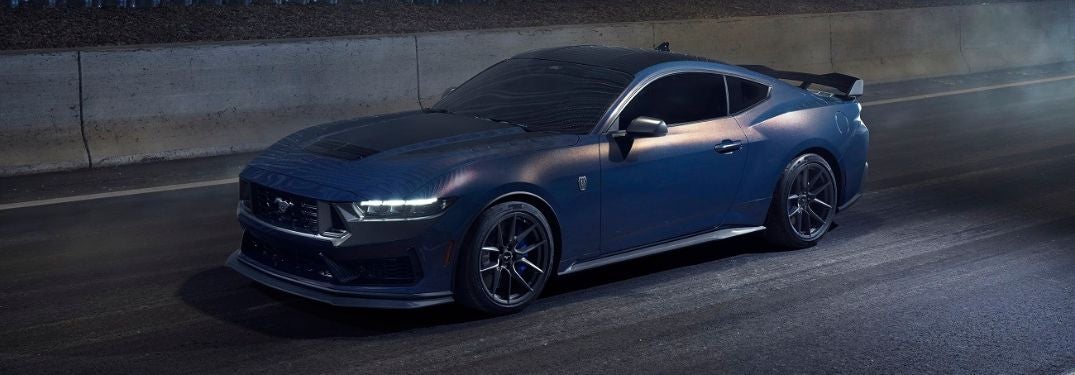
Blue 2024 Ford Mustang Dark Horse in a Tunnel
  Do you crave adrenaline-pumping thrills? Do you love heart-pounding speed? You will enjoy all of the above when you get behind the wheel of the next-generation 2024 Ford Mustang. The 7th-Generation Ford Mustang is faster, more powerful, more innovative and more impressive than ever - and that is just the standard Ford Mustang GT. Power enthusiasts and adrenaline junkies will love the brand-new and track-tuned 2024 Ford Mustang Dark Horse. Learn more about the latest Ford Mustang with an overview of the 2024 Ford Mustang Dark Horse release date and engine specs created by Benna Ford.

When Will the 2024 Ford Mustang Dark Horse Be Available in Wisconsin?

Wisconsinites who love power and performance when they get behind the wheel can expect to see the 7th-Generation 2024 Ford Mustang at dealerships in Summer 2023. When it makes its debut at Benna Ford, drivers will have a pair of standard models to choose from - Mustang EcoBoost® and Mustang GT - that are available in coupe and convertible body styles. The track-focused 2024 Ford Mustang Dark Horse is expected to arrive in the same timeframe with upgraded performance attributes and a more aggressive style.
2024 Ford Mustang 5.0-Liter V-8 Engine
2024 Ford Mustang Dark Horse Taillight and Exhaust

How Much Power Does the 2024 Ford Mustang Dark Horse Have?

The 2024 Ford Mustang sets the bar high for the iconic muscle car with an impressive engine lineup that is more powerful than ever. The entry-level Ford Mustang EcoBoost® employs the most powerful standard engine in a Ford Mustang to date with a 2.3-liter EcoBoost® four-cylinder that produces 315 horsepower and 350 pound-feet of torque. The ever-popular Ford Mustang GT uses a 4th-Generation 5.0-liter Coyote V-8 that is capable of 486 horsepower and 418 pound-feet of torque - making it the most powerful naturally-aspirated eight-cylinder Ford Mustang ever. The Ford Mustang Dark Horse is a horse of a different color and will challenge many competitors in its class. Powered by a performance-engineered 5.0-liter Coyote V-8 power core, the 2024 Ford Mustang will make 500 horsepower and 418 pound feet of torque with a responsive six-speed TREMEC® manual transmission. That is the most powerful eight-cylinder engine in any Ford Mustang that does not have the Shelby® name attached to it.
2024 Ford Mustang Dark Horse Wheels and Brakes
2024 Ford Mustang Steering Wheel and Dashboard

What Are the 2024 Ford Mustang Dark Horse Performance Features?

Gearheads who are drawn to the power and performance of the 2024 Ford Mustang Dark Horse may want to know what makes this mechanical masterpiece tick. We are here to help at Benna Ford. The Ford Mustang Dark Horse employs an engine that relies on Ford Performance features to provide next-level performance. Performance upgrades to the Ford Mustang Dark Horse engine include a re-balanced crankshaft and forged piston connecting rods that were first used by the Ford Mustang Shelby® GT500® and allow the track-focused Mustang to handle higher cylinder pressure and piston speeds. High-strength camshafts provide added durability on the track and allow the Mustang Dark Horse to hit an incredible 7,500-rpm redline. Additional performance features that promise to make the 2024 Ford Mustang Dark Horse stand out include a MagneRide® adaptive suspension system, 19-inch Brembo® front brakes with 13.9-inch brake rotors, a Ford Performance strut tower brace for enhanced steering, a Torsen® rear differential and 19-inch wheels with Pirelli P ZERO™ tires. Lightweight carbon fiber wheels by Carbon Revolution will be available later after launch.
READ MORE: 2023 Ford Bronco Raptor vs 2023 Jeep Wrangler Rubicon 392

Are you interested in the performance-tuned 2024 Ford Mustang Dark Horse? We hope that this overview of the 2024 Ford Mustang Dark Horse release date and engine specs will highlight the latest in an iconic lineup. Contact the Benna Ford Team for more information on the 2024 Ford Mustang and to get pre-approved for financing on your next Ford!
Posted in:

Related Posts

2024 Ford Maverick at Home

Ford Maverick Is Autoblog’s Best Compact Truck For 2024

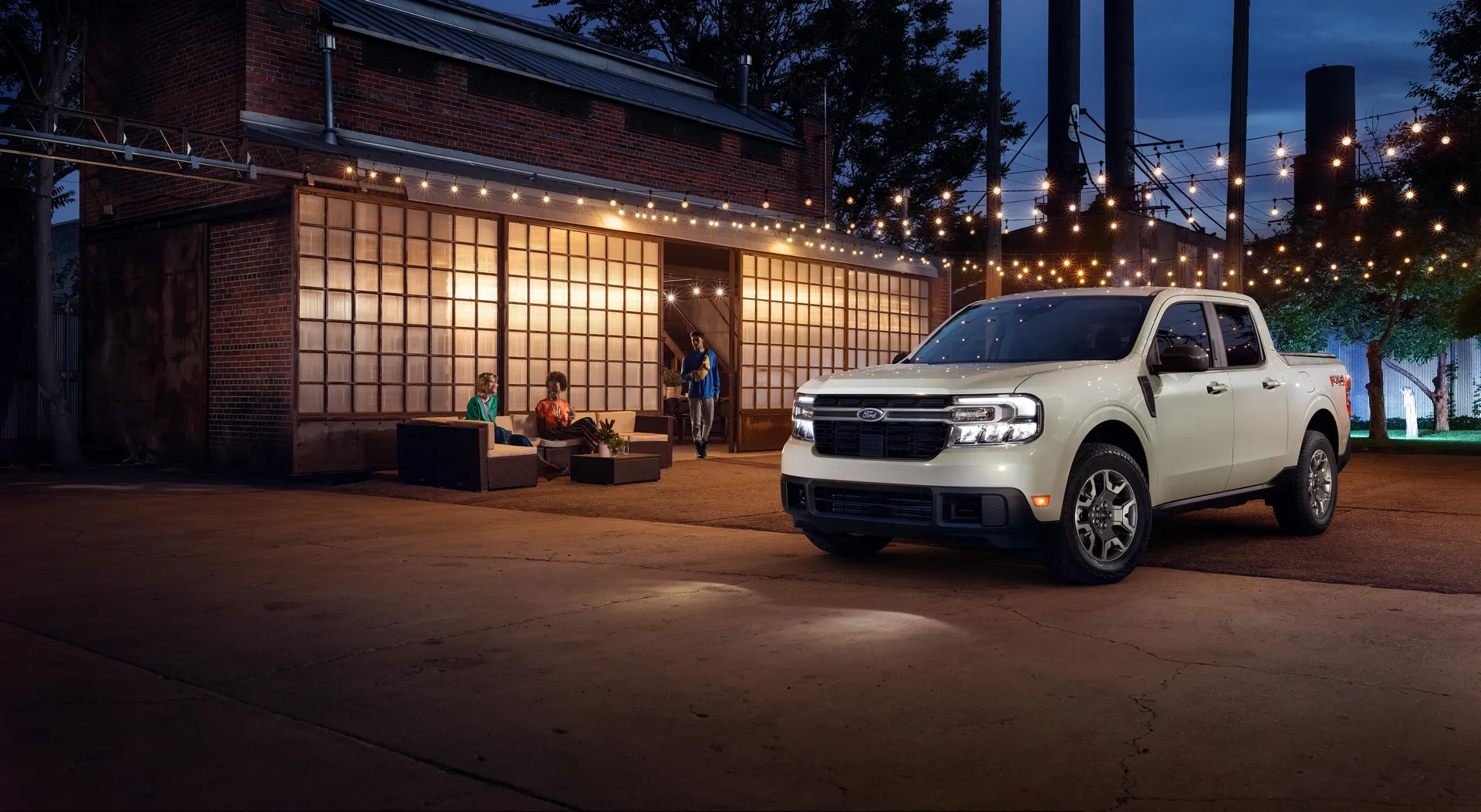
The Ford Maverick has been a firestarter as a brand new truck for people who wouldn’t usually look at buying a truck. The Maverick is available as either a hybrid or a turbocharged 4-cylinder, each getting excellent fuel mileage and still having a 4.5-foot bed in which you can haul up to 1,500 lbs of stuff. Who Is Autoblog.com? Autoblog.com, one of the largest automotive news and review websites, ranked the best compact trucks for 2024 and gave the Maverick an 8 out of 10 score, besting its nearest rival, the Hyundai Santa Cruz. What made Autoblog love the Maverick so much? What Autoblog Had To Say “There was a time in America when choosing the best compact truck was an extremely difficult proposition. Not terribly long ago, buyers could find a small pickup truck or two in virtually every new-car showroom. Those days are long gone, as offerings like the Ford Ranger, Chevrolet S-10 (and later Colorado), Nissan Hardbody and Toyota Tacoma grew in size over the years or were discontinued (and in some cases reborn or renamed) to make up the category we now know as midsize trucks. Interestingly enough, a couple of automakers re-entered the compact pickup segment in 2022 with surprisingly different takes on the small truck formula. So which of the two options is the best compact truck in America? We think most buyers will be best served by the Ford Maverick if they are buying a truck to serve as an implement to move people and cargo.” Price, Engines, And Drivetrain, Oh My Besides being a small truck, what makes the Maverick so appealing to prospective buyers? For 2024, the small Ford has a base MSRP of $23,815. It is available with either a 2.5-liter Atkinson cycle 4-cylinder that has a combined output of 191 horsepower and standard front-wheel drive or the available 2.0-liter EcoBoost 4-cylinder that produces 250 horsepower and 277 lb-ft of torque available in either front or all-wheel drive. Both engines can be optioned with three trim levels: XL, XLT, and Lariat. An 8-speed automatic transmission is standard for all models. Fuel Economy When equipped with the hybrid motor, the Maverick can achieve 42 mpg city and 33 mpg highway. When opting for the EcoBoost, customers can see up to 23 city and 30 highway mpg when equipped with front-wheel drive or 22 and 29 when optioned with all-wheel drive. The top-of-the-line Tremor option will get 20 mpg city and 24 on the highway. Towing Capabilities All Maverick models can tow 2,000 lbs as standard. However, a towing package can be optioned that increases the usability to 4,000 lbs. Interior Technology No matter which Maverick you choose, buyers will get an 8-inch center touchscreen with Apple CarPlay and Android Auto. With FordPass Connect, you will have a WiFi hotspot that as many as ten devices can access simultaneously. Safety Features Ford CoPilot 360 is also standard on all Maverick models and features Pre-Collision Assist with Automatic Emergency Braking and Automatic High Beam Headlamps, as well as available Adaptive Cruise Control with Stop & Go, Blind Spot Information System with Cross-Traffic Alert, Lane Centering, and Evasive Steering Assist. At Benna Ford, we offer our customers some of the best prices and services. With more than 100 new and used vehicles to choose from, our outstanding sales team and finance department will work hard to make sure you drive away happy. And our fantastic service department will take care of your new-to-you vehicle as if it were their own.

1694528410564_converted

Ford’s Pro Access Is the Latest in 100 Years of Ford Tailgates

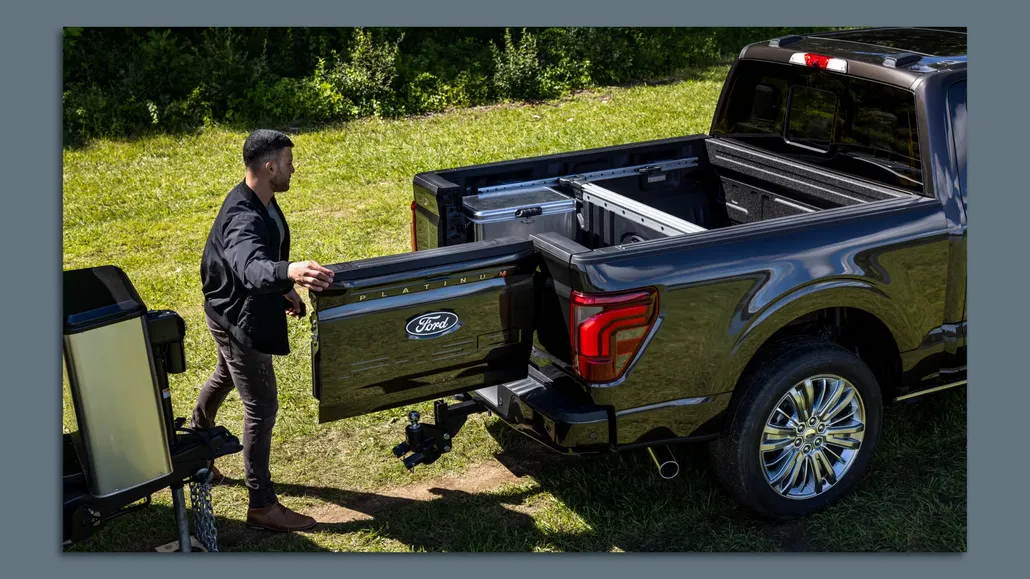
Available on the F-150 Lariat and Tremor and standard on King Ranch and Platinum, Ford’s Pro Access Tailgate is the latest in tailgate design. A visit to Benna Ford will quickly demonstrate how its side-swinging door within the traditional tailgate promises to solve some problems that have long plagued traditional tailgate design. It is also the latest in Ford’s long tradition of tailgate innovation. The Basics Were Set in 1927 The basic form of the tailgate has changed little since the 1927 Model A Wagon and truck. It was the width of the cargo area, bottom hinged with supports on either side that held it to a horizontal position when lowered. Initially, those supports were simply chains. They hung in a loop when the tailgate was up and bounced against the inner walls. In 1964, Ford replaced the chains with hinged metal bars that folded within the tailgate sides and stayed quietly in place. How the Tailgate Both Provides and Hinders Access One issue with the standard tailgate design is that an open tailgate keeps one away from the load in the bed, making it more challenging to position items in the bed, make adjustments, and reach for things to unload. In 1980, Ford combatted this with the easily removable tailgate. Though a bit cumbersome, the removed tailgate did allow a person much easier access to loading and unloading the bed. Interestingly, Ford developed a precursor to the Pro Access in 1966 on its full-size station wagons with a feature called the Magic Doorgate. An available feature at the time was seats on each side of the cargo area, each of which could fit one adult or two children. To prevent those passengers from having to crawl over the tailgate to get in and out, Ford created the Magic Doorgate, in which the full tailgate opened to the side and down. As this was for passenger accommodation, Ford did not extend this feature to its pickup trucks. The 2000s Provided an Explosion of Tailgate Ideas In the mid-2000s, Ford showed they paid considerable attention to the tailgate. In another move to improve access to the truck bed in 2006, Ford created a step extension for the King Ranch model. This would drop down at a height approximately halfway between the lowered bed and the ground and out a bit to help you step into the cargo bed. The following year, they showed a Pickup concept in which the entire tailgate would power downward horizontally to both act as a step and give the operator access to the bed while standing on the gate. It never went into production. In 2008, however, Ford addressed the issue of using the tailgate as an extension of the bed but subsequently leaving the rear open. Available on Super Duty trucks, the Bed Extender was a three-sided cage that could rotate out to create an enclosure on top of the extended gate for long loads. When not needed, the extender would rotate inside to divide the cargo bed or collapse out of the way.  In 2021, Ford used the bedliner composite molding on the tailgate to create an on-site workbench with a built-in yardstick, grooves for pencil holders, and other clever shapes to assist working. Ford’s Pro Access is the Best Tailgate Innovation Yet Ford’s latest and most comprehensive innovation is the Pro Access tailgate.  Here, the middle 60% of the tailgate, or 37 inches, is hinged on the passenger side to swing out of the way to give you access to the cargo bed. The swing-out gate has check-stops at 37, 70, and 100 degrees. The first check stop addresses a long-term issue with traditional tailgates when towing, in which a trailer jack hampers the ability to lower the tailgate. The 37-degree check is designed to stop just short of the trailer jack to give the operator bed access. When there is no trailer, the 70-degree stop provides easier access while still remaining within easy reach to close.  Opening it 100 degrees gets it completely out of the way for unloading. A wider kick step on the bumper under the license plate provides a convenient step for entering the cargo bed area. That the Pro Access hardware adds 62 pounds to the tailgate weight is not an issue because every Pro Access tailgate comes standard with power raising and lowering. By contrast, GM’s Multi-flex tailgate does not address the trailer jack issue, and Ram’s 60/40 side swinging tailgate adds 75 pounds and has no power function. The Pro Access tailgate is both the latest in Ford’s long history of tailgate innovation and just an example of the clever, user-based thinking that Ford puts into all of its trucks. Take a look at the best and best-selling trucks in the U.S. at Benna Ford.

Ford Mustang GTD_Road to the Ring_03_converted

​​Mustang GTD is the Fastest American Production Car to Lap the Nürburgring​

While acceleration times like 0-60 and quarter-mile times are useful and well-established, the ultimate performance metric for a high-performance vehicle is how fast it can lap the Nürburgring in Germany. Benna Ford is pleased to announce that the Ford Mustang GTD has entered an extremely exclusive club by lapping the “ring” in under seven minutes. Only six production models worldwide can claim to be in the “Under seven” club; the Mustang GTD is the only one from America. The specifics are this: On December 10, 2024, the 815-horsepower Mustang GTD, driven by Multimatic Motorsports driver Dirk Müller, completed the 12.9-mile 73-turn lap in 6 minutes, 57.685 seconds. This marks an achievement of a goal stated by Ford CEO Jim Farley at the Mustang GTD’s debut in August 2023. “The team behind Mustang GTD took what we’ve learned from decades on the track and engineered a Mustang that can compete with the world’s best supercars,” said Ford President and CEO Jim Farley. “We’re proud to be the first American automaker with a car that can lap the Nürburgring in under seven minutes, but we aren’t satisfied. We know there’s much more time to find with Mustang GTD. We’ll be back.” Ford has produced several blisteringly fast Mustangs in the past couple of decades, and some Shelby Mustangs even have greater horsepower than the GTD. However, even they aren’t as race-track-bred as the Mustang GTD. It began with the Ford Mustang GT3 race car, developed by Ford Performance and Multimatic Motor Sports, to compete in IMSA endurance races, such as the 24 Hours of LeMans, 12 Hours at Sebring, and 24 Hours of Daytona. The goal was to create a high-performance production car inspired by and derived from the Mustang GT3. This is a more challenging task than it sounds. Not only do production cars need to meet all manner of Department of Transportation and NHTSA safety standards, but the engine can’t be expected to be rebuilt after every long day of driving, as in a race car. At the heart of the Mustang GTD (taking its name from the GT Daytona IMSA class) is a Ford Performance-engineered 5.2-liter naturally aspirated (non-turbo or supercharged) V8 tuned to achieve 815 horsepower.  The engine features a dry sump oil system to prevent oil starvation on fast curves and is the first dry sump fitted to a production Mustang.  The V8 is paired with an 8-speed dual-clutch transaxle driving and is located between the rear wheels to help produce a 40/40 weight distribution. The chassis features a semi-active suspension with short-long arm geometry up front to handle High-G cornering, while carbon-ceramic brakes slow things down when necessary. Much of the body is made of carbon fiber panels, including the large rear wing, which forms road-gripping downforce at speed. As mandated by the Nürburgring, the production car was fitted with a competition seat with a five-point harness and a roll cage. Ford plans a limited run of about 1,000 Mustang GTDs. With a starting MSRP of about $325,000, it is more than a mere step up from a Mustang GT, so you will unlikely find one in Benna Ford’s inventory. That said, it is a testament to Ford’s engineering prowess and is an example of lessons learned on the track finding their way into production cars.